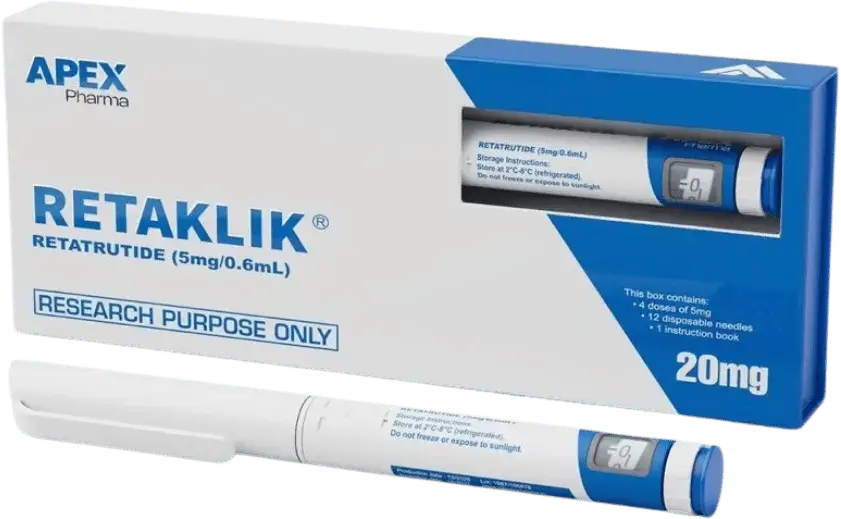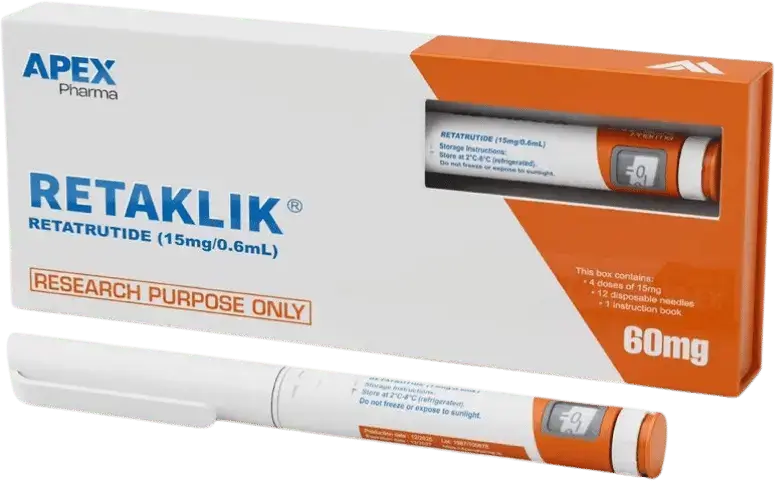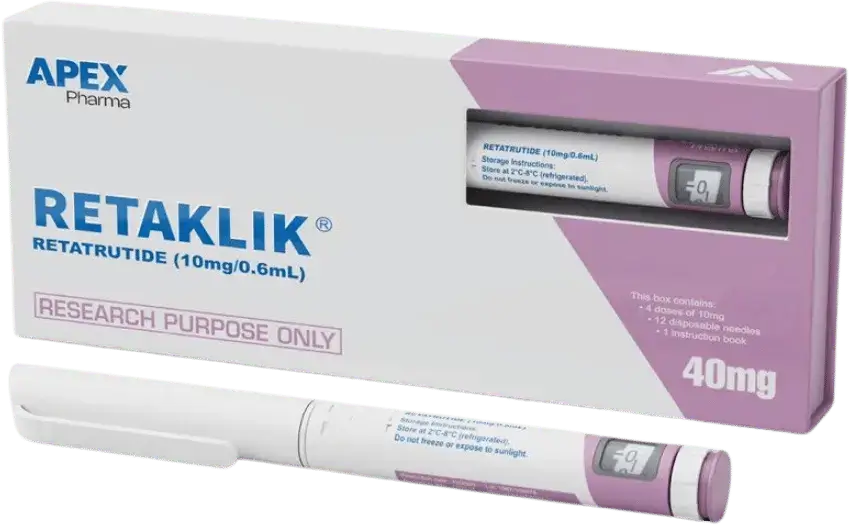
Retatrutide 40 mg
Larger volumes? Bulk and wholesale pricing is available on request.
Overview
Retatrutide 40mg Pen is a pen-formulation that contains a total of 40mg of retatrutide. Combined with the activity in the three hormone-receptor pathways, the compound – the development code LY3437943 -has emerged as a key focus of metabolic research.
Retatrutide acts on GIP, GLP-1 and glucagon receptors. It has a triple-receptor mechanism, which is different from semaglutide (which selectively targets GLP-1) and tirzepatide (which has both GIP and GLP-1 receptor agonism).
With the clinical development, the search for Retatrutide 40mg Pen UK, Retatrutide 40mg, Retatrutide UK, Retatrutide weight loss, and Retatrutide vs tirzepatide has picked up.
The name of the product is important to note when reading: 40mg indicates the amount of total product in the pen. It cannot be understood as a conventional 40mg dose or a specific treatment advice.
What Is a Retatrutide 40mg Pen?
A Retatrutide 40mg Pen is a pen presentation labelled as containing a total quantity of 40mg of retatrutide.
Retatrutide itself is an investigational peptide developed to activate three receptors associated with metabolic signalling:
- GIP receptor
- GLP-1 receptor
- Glucagon receptor
Because three receptor systems are involved, retatrutide is frequently referred to as a triple receptor agonist or simply a triple agonist.
The 40mg designation relates to the stated contents of the complete pen presentation. It is separate from the individual doses and dosing schedules evaluated during controlled clinical studies.
How Does Retatrutide Work?
The mechanism of action of retatrutide is through its dual GLP-1 receptor and glucagon receptor agonist activity and its GIP receptor agonist activity.
Metabolic pathways share specific functions in metabolic physiology.
GLP-1 is active in the following processes, among others, which involve glucose-dependent insulin secretion, appetite-related signalling and gastric emptying. GIP is a nutrient-dependent incretin hormone that is linked to insulin signalling.
Glucagon plays important role in glucose homeostasis and energy metabolism.
Retatrutide combines activity in these 3 pathways into one molecule. Scientists are studying whether this dual receptor action has a different metabolic effect than agents that activate fewer receptors.
Retatrutide 40mg Pen and Weight-Loss Research
Much of the interest has focused on research about obesity and body weight changes.
The 338 adult participants in one Phase 2 clinical trial had a history of obesity (or overweight) and at least one weight-related condition. The participants were followed for 48 weeks and researchers studied a number of combinations of retatrutide.
The participants on the regimen studied at 48 weeks lost an average of 24.2% of their body weight, while the placebo group lost an average of 2.1%.
In addition, 1mg, 4mg and 8mg regimens were also part of the study.
The results reported herein are those of controlled clinical trials with specific doses. They are not to be construed as results which can only be related to the use of a Retatrutide 40mg Pen as a result of the whole pen being marked as 40mg.
In other words, 40mg total pen contents is not a 40mg clinical dose.
Retatrutide vs Semaglutide and Tirzepatide
Although retatrutide, semaglutide and tirzepatide are frequently discussed together, they have different pharmacological profiles.
Their principal receptor activity can be summarised as follows:
Semaglutide: GLP-1 receptor agonist
Tirzepatide: GIP + GLP-1 receptor agonist
Retatrutide: GIP + GLP-1 + glucagon receptor agonist
Comparatively, semaglutide is a single-receptor drug, whereas tirzepatide is a dual receptor drug. Retatrutide combines the effect of glucagon-receptor agonism with the effects of GIP and GLP-1.
This difference is statistically significant, but indeed does not prove that a triple agonist is superior to a single or dual agonist. Comparisons must be appropriate, based on clinical evidence, studied population, doses, endpoints, and duration and safety findings.
What Does 40mg Mean on a Retatrutide Pen?
For a product labelled Retatrutide 40mg Pen, the 40mg figure generally describes the stated total amount of retatrutide associated with the entire pen.
It does not establish:
- a recommended 40mg dose;
- a standard weekly amount;
- an approved treatment schedule; or
- a clinically validated 40mg regimen.
This distinction matters because retatrutide clinical trials have evaluated specific investigational doses.
For example, the published Phase 2 obesity trial studied once-weekly regimens ranging from 1mg to 12mg. The fact that a pen contains a stated total quantity of 40mg does not mean that the complete contents correspond to a studied clinical dose.
Why Has Retatrutide Attracted Attention?
Retatrutide is a novel incretin therapy that goes beyond GLP-1.
It is not just the fact that three receptors are targeted. The interaction of these pathways and the effect on metabolic responses when both are targeted simultaneously are being investigated.
Both GIP and GLP-1 have known functions in incretin biology, and glucagon has an additional pathway in glucose and energy regulation.
LY3437943 is an important compound in the current metabolic research studies because it can be studied in these three mechanisms together.
Retatrutide 40mg Pen UK
The interest in Retatrustide 40mg Pen UK has grown as part of the general interest in GLP-1 receptor agonists and newer multi-receptor therapeutics.
But retatrutide’s regulatory status must be solidified.
Retatrutide is an investigational drug that is still being developed. The results of clinical trials with retatrutide should therefore not be confused with independently marketed product that can be found online as Retatrutide 40mg Pens.
Use of an online pen does not imply that the pen is an authorised Lilly medicine or the same Lilly-sponsored clinical trial pen.
The product description should make it clear that the number of doses in the total stated pen contents is different from the number of doses tested in the clinical development program.
Specifications
Certificate of Analysis
Independent third-party analysis for the current batch. Verify identity and purity before use.
Storage & handling
Shipping
Orders placed before 15:00 GMT on a working day are dispatched the same day from the United Kingdom in temperature-conscious, discreet packaging. Tracked UK delivery typically arrives within 1–2 working days; international timelines vary by destination and customs.
A Retatrutide 40mg Pen is a pen-format product described as containing a stated total quantity of 40mg of retatrutide. Retatrutide is an investigational compound, also known as LY3437943, with agonist activity at GIP, GLP-1 and glucagon receptors. The 40mg figure identifies the stated total pen contents rather than an established individual dose.
No. The 40mg designation should not be interpreted as a recommended single or weekly dose. It refers to the stated total quantity associated with the complete pen presentation. Clinical trials have used specifically defined investigational regimens, including doses substantially below 40mg.
The retatrutide molecule activates three receptors: GIP, GLP-1 and glucagon. These pathways participate in different aspects of metabolic regulation, including glucose homeostasis, appetite-related signalling and energy metabolism. Its simultaneous activity across three receptors is the basis for the term “triple receptor agonist.”
Retatrutide is also identified as LY3437943, particularly in scientific and clinical-development literature. It may additionally be described as a GIP/GLP-1/glucagon receptor agonist or triple agonist. Some online sources use the nickname “GLP-3,” although this is not a scientifically accurate classification of retatrutide.
Clinical research has investigated retatrutide in adults with obesity and overweight. In a published Phase 2 trial involving 338 participants, the studied 12mg regimen was associated with an average 24.2% reduction in body weight after 48 weeks, compared with 2.1% for placebo. Retatrutide has subsequently progressed through Phase 3 clinical development. These findings concern particular investigational doses and controlled study conditions. They should not be interpreted as predicted results from an independently marketed Retatrutide 40mg Pen.
The description comes from the number of receptor pathways retatrutide activates. Instead of focusing only on GLP-1, retatrutide combines activity at GIP, GLP-1 and glucagon receptors. This provides researchers with a way to investigate how three related metabolic signalling pathways behave when targeted through one molecule.
Tirzepatide and retatrutide share activity at two receptor pathways, but they are not the same compound. Tirzepatide targets GIP and GLP-1 receptors. Retatrutide targets GIP, GLP-1 and glucagon receptors. Glucagon-receptor agonism is therefore an important pharmacological distinction between the two.
Storage should follow the conditions provided with the specific product and its genuine manufacturer documentation. Storage requirements can vary depending on the formulation and presentation. Generic instructions found for other retatrutide products should not automatically be assumed to apply to a particular 40mg pen.
Retatrutide remains an investigational compound and should not be presented as an established authorised retatrutide medicine in the UK. Clinical research involving retatrutide does not constitute regulatory approval of independently marketed Retatrutide 40mg Pens.
Retatrutide remains under clinical investigation. Lilly has stated that its retatrutide is available through its clinical-trial programme rather than as an approved medicine for general public use. An online product advertised as a Retatrutide 40mg Pen should therefore not be represented as Lilly's authorised product or assumed to be identical to the retatrutide used in Lilly-sponsored trials. Consumers should be particularly cautious about claims concerning product identity, manufacturer, regulatory approval or equivalence to clinical-trial retatrutide.
What researchers say
Mass spec identity confirmation on the COA is a rarity at this price point. Material behaved exactly as expected in our in-vitro assays across two separate batches.
Ordered the 40 mg presentation for a dose-response series. Vials arrived well protected, batch-matched paperwork included, and the team answered a documentation query within hours.
Consistent quality across our last three orders. Would like to see the COA downloadable before purchase as standard, but the material itself has been faultless.
Intended applications are limited to laboratory research such as receptor-binding assays and in-vitro metabolic studies. Not for human or animal administration. Retatrutide is not an approved medicine.