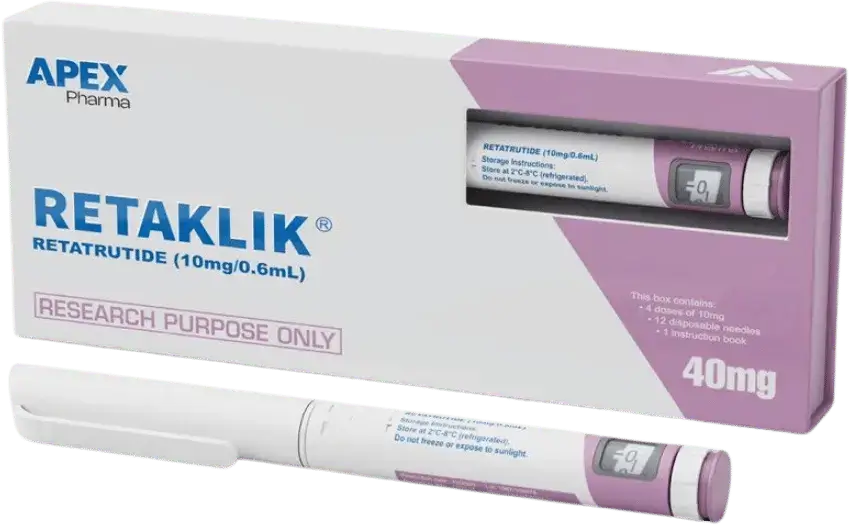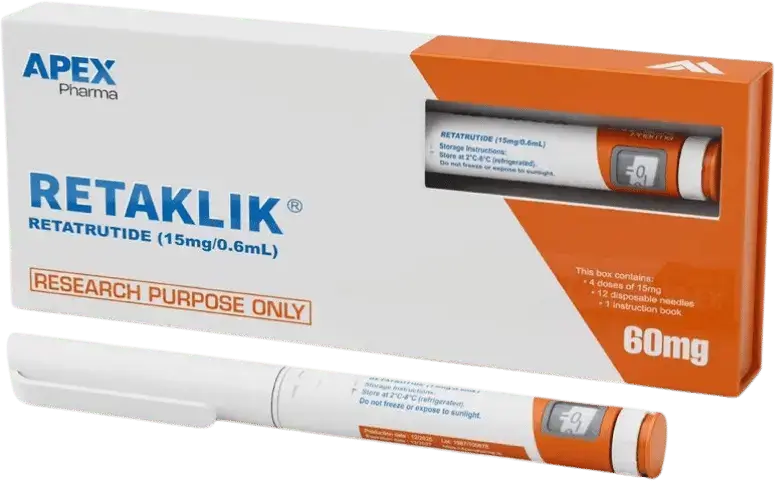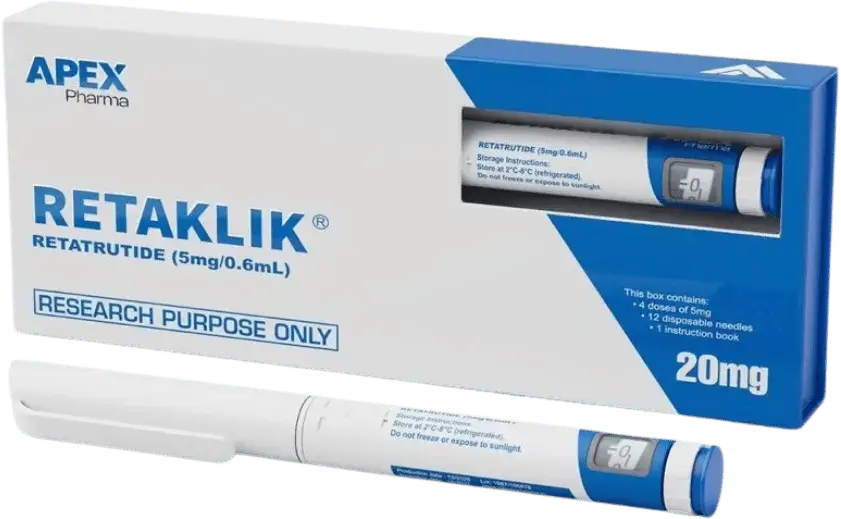
Retatrutide 20 mg
Larger volumes? Bulk and wholesale pricing is available on request.
Overview
Retatrutide 20mg is a research dosage of retatrutide, a peptide that has garnered much interest in the field of metabolic and obesity research. Retatrutide, or LY3437943, is also notable because it targets three hormone-receptor pathways, as opposed to just one.
Clinical research published about this compound has led to an increase in interest among people looking for its name variations like Retatrutide 20mg UK, Retatrutide UK, Retatrutide weight loss, and Retatrutide vs tirzepatide. The “20mg” in Retatrutide 20mg is considered to be the amount of material listed in this particular presentation. Do not look upon as a set or recommended 20mg clinical dose.
What Is Retatrutide 20mg?
Retatrutide is a peptide-based investigational compound that acts on 3 receptors: GIP receptor, GLP-1 receptor, and glucagon receptor. This mechanism is why it can be considered a triple hormone receptor agonist.
This is different to semaglutide that works mostly through the GLP-1 receptor and tirzepatide that works on both GIP and GLP-1 receptors.
This extra glucagon-receptor activity makes retatrutide a very interesting compound, particularly for people studying the incretins, energy balance and metabolic signalling.
How Does Retatrutide Work?
The study of retatrutide is primarily about the combined effects of three signalling pathways.
GLP-1 has a relationship with appetite, glucose regulation and gastric emptying. Another incretin hormone, GIP, is also related to metabolic and insulin-related signalling. Glucagon has important roles in glucose and energy metabolism.
The multiple receptor activation of retatrutide is thus one of the primary factors that has been gaining interest in metabolic research.
Retatrutide and Weight-Loss Research
Retatrutide weight loss is one of the top search items in the UK. Many of the interests are fueled by results from controlled clinical research.
The study aimed to assess the effects of various doses of retatrutide over 48 weeks in a Phase 2 clinical trial that included 338 adults with obesity or overweight and a weight-related condition. At 48 weeks, participants taking the studied 12mg regimen lost an average of 24.2% of their body weight while those on the placebo group lost 2.1%.
The study also studied regimens of 1mg, 4mg and 8mg. The results presented here are only from controlled clinical-trial protocols and may not be applicable to the product without further study because it contains 20mg of retatrutide.
Retatrutide vs Semaglutide and Tirzepatide
The easiest way to understand the difference between these compounds is through their receptor activity:
- Semaglutide: GLP-1 receptor agonist
- Tirzepatide: GIP + GLP-1 receptor agonist
- Retatrutide: GIP + GLP-1 + glucagon receptor agonist
This triple-receptor mechanism does not automatically mean that retatrutide is superior. Instead, it represents a different pharmacological approach that researchers are continuing to investigate.
What Does Retatrutide 20mg Mean?
The typical usage of 20mg is for a product that is stated as containing 20mg of the total product.
This distinction is significant especially as there is published clinical research for specific dosing schedules. For instance, the Phase 2 obesity study did not determine 20mg as a standard clinical dose; rather, it had a number of different doses ranging from 1mg to 12mg per day.
Retatrutide 20mg UK Research
When assessing the quality and the effect of Retatrutide 20mg, UK researchers are advised to take into account the scientific literature. The following are important points to consider: Batch identification, analytical testing, stated purity, traceability and access to a batch-specific Certificate of Analysis (COA).
Retatrutide is a study drug and any research results must be viewed in the context of the experimental or clinical protocols used to generate the results.
Retatrutide 20mg is also a valuable target for further research in the field of triple-receptor signalling and the synergies between metabolic pathways involving GIP, GLP-1 and glucagon.
Specifications
Certificate of Analysis
Independent third-party analysis for the current batch. Verify identity and purity before use.
Storage & handling
Shipping
Orders placed before 15:00 GMT on a working day are dispatched the same day from the United Kingdom in temperature-conscious, discreet packaging. Tracked UK delivery typically arrives within 1–2 working days; international timelines vary by destination and customs.
Retatrutide 20mg refers to a presentation containing a stated total quantity of 20mg of retatrutide. Retatrutide, also known by the development code LY3437943, is an investigational peptide being researched for its effects on metabolic pathways. It acts as a triple receptor agonist targeting GIP, GLP-1 and glucagon receptors.
The 20mg refers to the stated total quantity of retatrutide in the product. It should not be interpreted as a recommended individual dose. Clinical research has investigated specific dosing protocols rather than establishing 20mg as a standard dose. For example, the published Phase 2 obesity trial evaluated once-weekly doses ranging from 1mg to 12mg.
The active compound retatrutide is designed to activate three hormone receptors: GIP, GLP-1 and glucagon. These receptors are involved in metabolic processes including appetite regulation, glucose metabolism and energy balance. This triple-receptor activity is what distinguishes retatrutide from compounds that target fewer incretin-related pathways.
Retatrutide is also known by its research/development identifier LY3437943. You may also see it described as a GIP/GLP-1/glucagon triple receptor agonist or simply a “triple agonist.” The informal term “GLP-3” is sometimes used online, but Lilly notes that this is not a scientifically accurate classification.
Retatrutide has been studied extensively in metabolic and obesity research. In a published Phase 2 trial involving 338 adults, the 12mg group experienced an average body-weight reduction of 24.2% at 48 weeks, compared with 2.1% with placebo. More recently, Lilly reported Phase 3 TRIUMPH-1 results in which participants receiving 12mg lost an average of 28.3% over 80 weeks. These findings relate to controlled clinical trials and specific studied doses; they should not be treated as expected results from a product labelled Retatrutide 20mg.
Interest in retatrutide primarily comes from its unusual triple-receptor mechanism. Instead of targeting only GLP-1, retatrutide simultaneously activates GIP, GLP-1 and glucagon receptors. Researchers are investigating how this combination affects body-weight regulation, glucose control and other aspects of metabolic health.
The main difference is the number of receptor pathways targeted. Semaglutide primarily targets GLP-1 receptors, while tirzepatide targets GIP and GLP-1 receptors. Retatrutide goes one step further by targeting GIP, GLP-1 and glucagon receptors. This pharmacological difference is one of the main reasons retatrutide has attracted research interest, although it does not by itself establish that retatrutide is better or more suitable than either semaglutide or tirzepatide.
Storage conditions should follow the documentation supplied with the specific Retatrutide 20mg product. Requirements can differ depending on whether the material is supplied lyophilised, in solution or in another research formulation. Researchers should therefore rely on the product-specific label, Certificate of Analysis and storage documentation rather than assuming that all retatrutide products have identical requirements.
For a research product, documentation and traceability are particularly important. Researchers should look for clearly identified batch information, stated quantity and composition, appropriate analytical testing and a batch-specific Certificate of Analysis (COA). Where purity claims are made, the documentation should also identify the analytical method used rather than relying solely on a percentage printed on a product page.
Retatrutide is still an investigational compound, and Lilly states that its retatrutide is currently available only within its clinical trials and is not available for public use. Products advertised online as “Retatrutide 20mg” should therefore not be presented as equivalent to an authorised Lilly medicine or established clinical product.
What researchers say
COA arrived with the vial and matched the batch number exactly. HPLC purity was consistent with the certificate when we ran our own verification. Exactly what a reference-grade supplier should look like.
Second order for our receptor-binding work. Lyophilised cake was intact on arrival, cold-chain packaging well done, and dispatch was genuinely next-day to our lab.
Documentation is the best we have seen from a peptide supplier — batch record, storage guidance, reconstitution notes. One star off only because the courier left the parcel with reception unsigned.
Intended applications are limited to laboratory research such as receptor-binding assays and in-vitro metabolic studies. Not for human or animal administration. Retatrutide is not an approved medicine.